
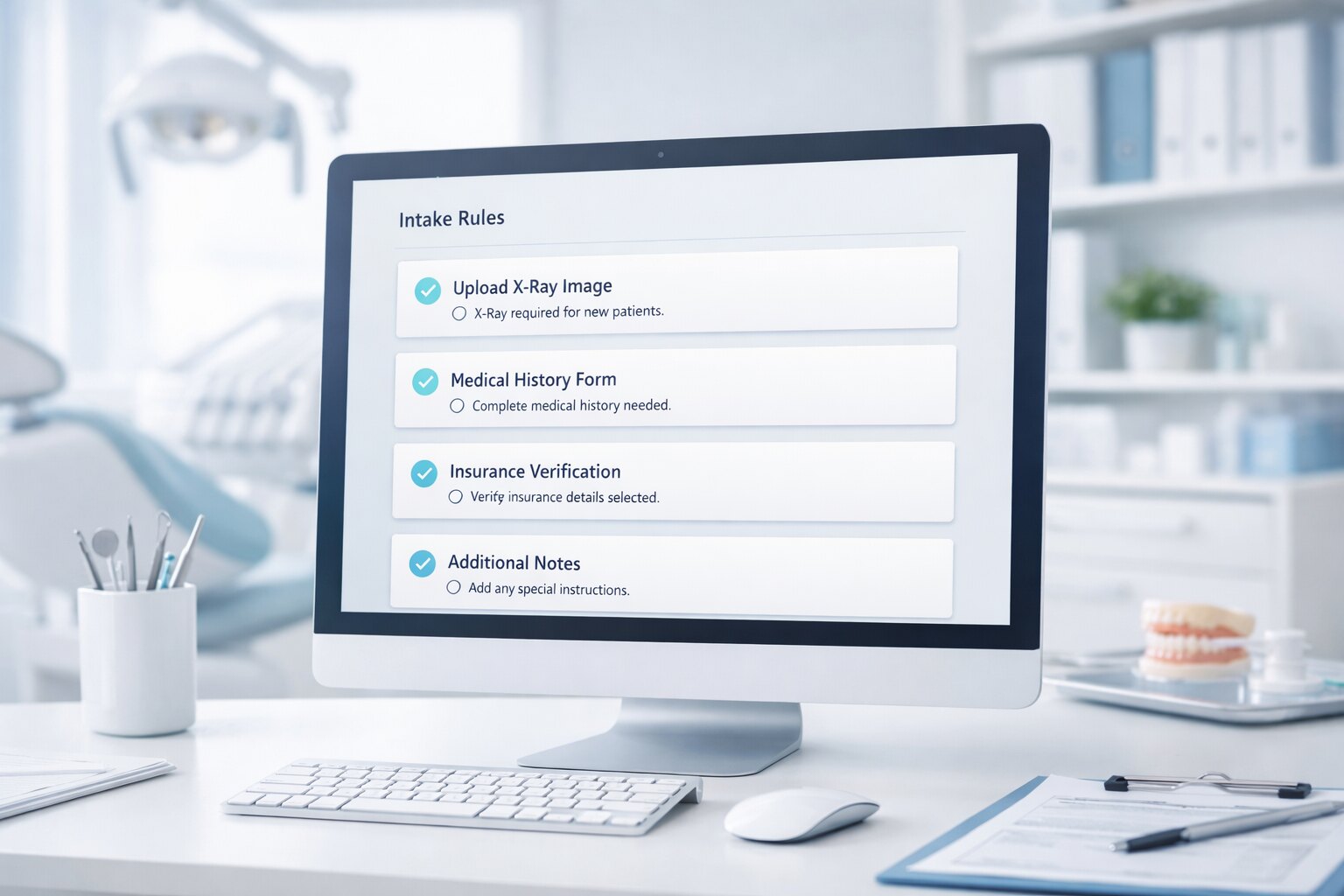
Intake Rules
See how lab-specific expectations become practical pre-send checks that protect capacity from missing details, missing evidence, contradictions, and unusable files.

A 2023 audit found inadequate design-diagram detail in 86.8% of partial denture prescriptions. (source)
The same audit found only 6.4% included a return date, so 94% left it out. (source)
The same audit found clinician contact details missing in 41.3% of prescriptions. (source)
Protect Lab Capacity
Labs need clear rules because the right submission depends on the case type, destination, required attachments, and realistic turnaround.
Show The Rules Early
Practices benefit when those rules become visible before the send moment instead of after the case is already delayed.
Warn Or Block Clearly
The best rules are practical and easy to act on, with clear warn and block behavior when a case is risky, incomplete, contradictory, or unusable.
Why Rules Exist
Rules protect capacity by making the real requirements visible before the work begins.
Intake rules exist because not every case needs the same submission. A removable case, an implant case, and a crown case can each require different files, notes, approvals, turnaround expectations, and case-specific details. When those rules stay invisible, the practice ends up guessing.
That guesswork is what creates avoidable clarification work later. Good labs are not adding rules for decoration. They are protecting capacity and making sure the right case arrives in a form that can actually move forward.
What Modern Rules Cover
Good rules describe the real inputs the lab needs to start the work and the practice needs to confirm.
Modern intake rules usually cover the practical questions that determine whether the lab can start. The best rule set is clear enough that a practice can understand what still matters before the submission is sent.
That is also why a good rule set feels short. The purpose is not to overwhelm the practice. The purpose is to clarify what would otherwise become a call or resend later. Once the lab is chosen, LabPreCheck can surface those rules and let AI-assisted PreCheck review the submission against them before send time. For the practice workflow view, pair this page with For Practices.
Required fields such as tooth numbers, material, implant system, connection, size, retention, or treatment objective for the selected case type.
Conditional details such as shade, stump shade, scan body type, clasp design, or protrusion value when the case context clearly calls for them.
Required files such as bite records, opposing scans, scan body references, supporting RX documents, or other evidence the lab needs to start.
Approval, turnaround, contradiction, and unusable-file checks, with warn-level review for weak evidence and block-level stops for missing or objectively unusable evidence.
Why Practices Benefit
The practice benefits most when the rules appear before the handoff is final.
From the practice side, the benefit of rules is simple. The team knows what still matters before the send moment. That prevents the handoff from depending on memory, old PDFs, or assumptions carried over from the wrong kind of case.
That is why LabPreCheck targets the practice workflow even when it is explaining the lab’s rules. The practice is where preventable confusion has the best chance to be fixed early. The next page to read is usually Case Readiness.